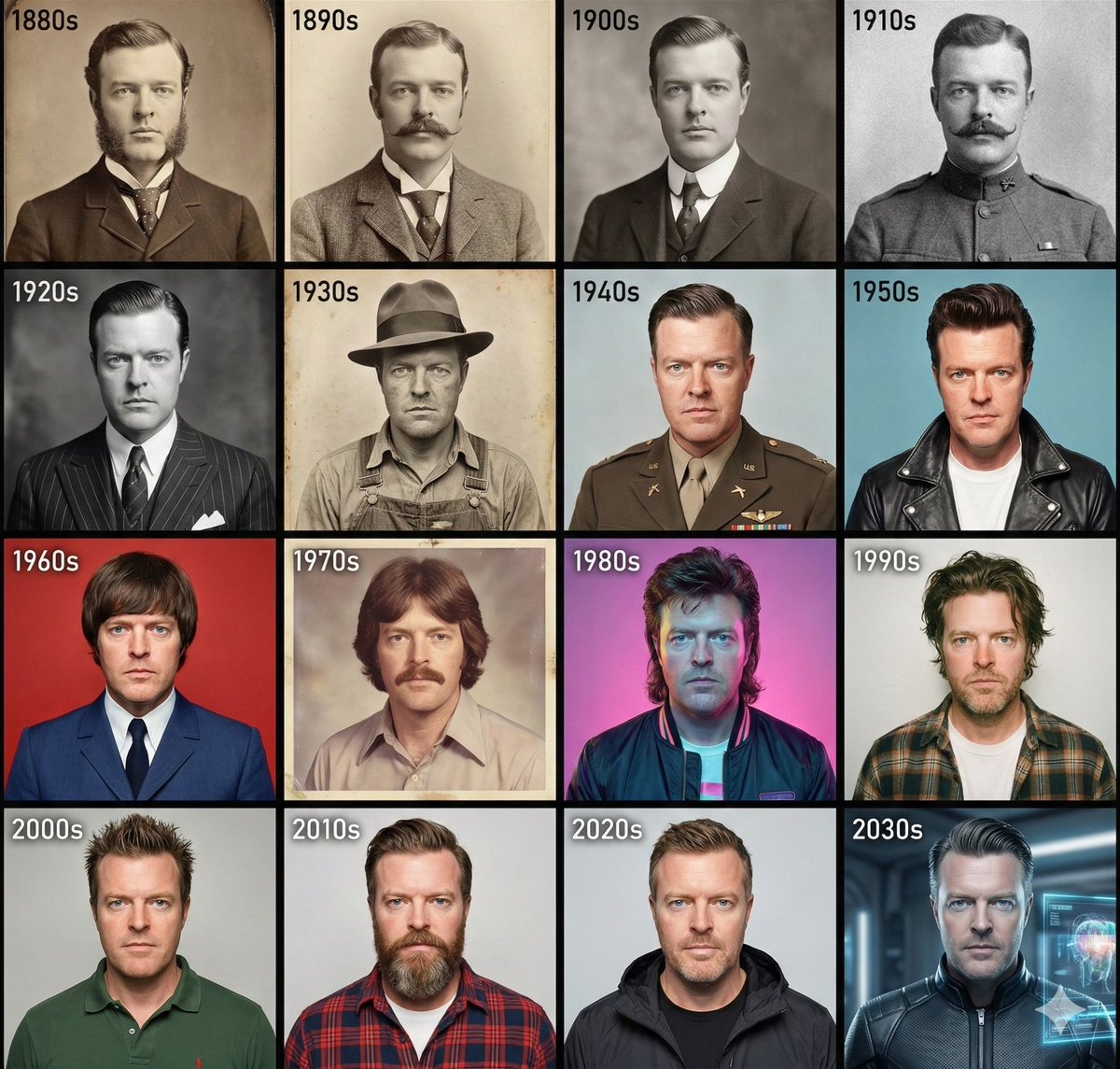
时光网格:1880年代起的时尚变迁之旅
BY Hannah Xu
// 2025.12.31
📝 PROMPT 提示词
人像
写实
👤 主要主体
同一男性人物在不同年代的时尚造型
🏞️ 场景描述
4×4网格,每个格子展示一个十年,背景和色调随年代变化
🎨 色调配色
随年代变化:早期为复古暖色调,中期为鲜艳色彩,现代为清晰冷色调
🎭 情绪氛围
怀旧、历史感、时尚演变、精致
🇨🇳 中文提示词
生成一个4×4网格图像,从1880年代开始,每个格子代表一个十年。每个格子中展示同一男性人物,穿着对应年代的典型服装(如1880年代的高领衬衫、马甲、长外套;1890年代的晨礼服;1900年代的西装;1910年代的军装风格;1920年代的宽松西装;1930年代的修身西装;1940年代的实用服装;1950年代的休闲西装;1960年代的摩登风格;1970年代的喇叭裤和花衬衫;1980年代的宽肩西装;1990年代的简约风格;2000年代的商务休闲;2010年代的智能休闲;2020年代的街头时尚)。发型、胡须和配饰(帽子、领带、眼镜、手表等)也需符合各年代特征。背景和色彩风格需匹配对应年代(如早期使用复古色调和胶片颗粒感,中期色彩逐渐鲜艳,现代使用数字感色调)。整体呈现时尚历史变迁的视觉效果。
🇬🇧 English Prompt
A 4×4 grid image starting from the 1880s, each cell representing a decade. In each cell, the same male figure appears styled with era-appropriate clothing (e.g., high-collared shirts, vests, long coats for the 1880s; morning coats for the 1890s; suits for the 1900s; military-inspired attire for the 1910s; loose suits for the 1920s; tailored suits for the 1930s; utilitarian wear for the 1940s; casual suits for the 1950s; mod styles for the 1960s; bell-bottoms and patterned shirts for the 1970s; power suits for the 1980s; minimalist fashion for the 1990s; business casual for the 2000s; smart casual for the 2010s; streetwear for the 2020s), hairstyle, facial hair, and accessories (hats, ties, glasses, watches, etc.). Backgrounds and color palettes match each decade (e.g., vintage tones and film grain for early eras, vibrant colors for mid-century, digital hues for modern times). Overall, a visual journey through fashion history, photorealistic style, detailed textures, cinematic lighting.
#时尚历史
#年代风格
#网格布局
#男性肖像
#复古到现代